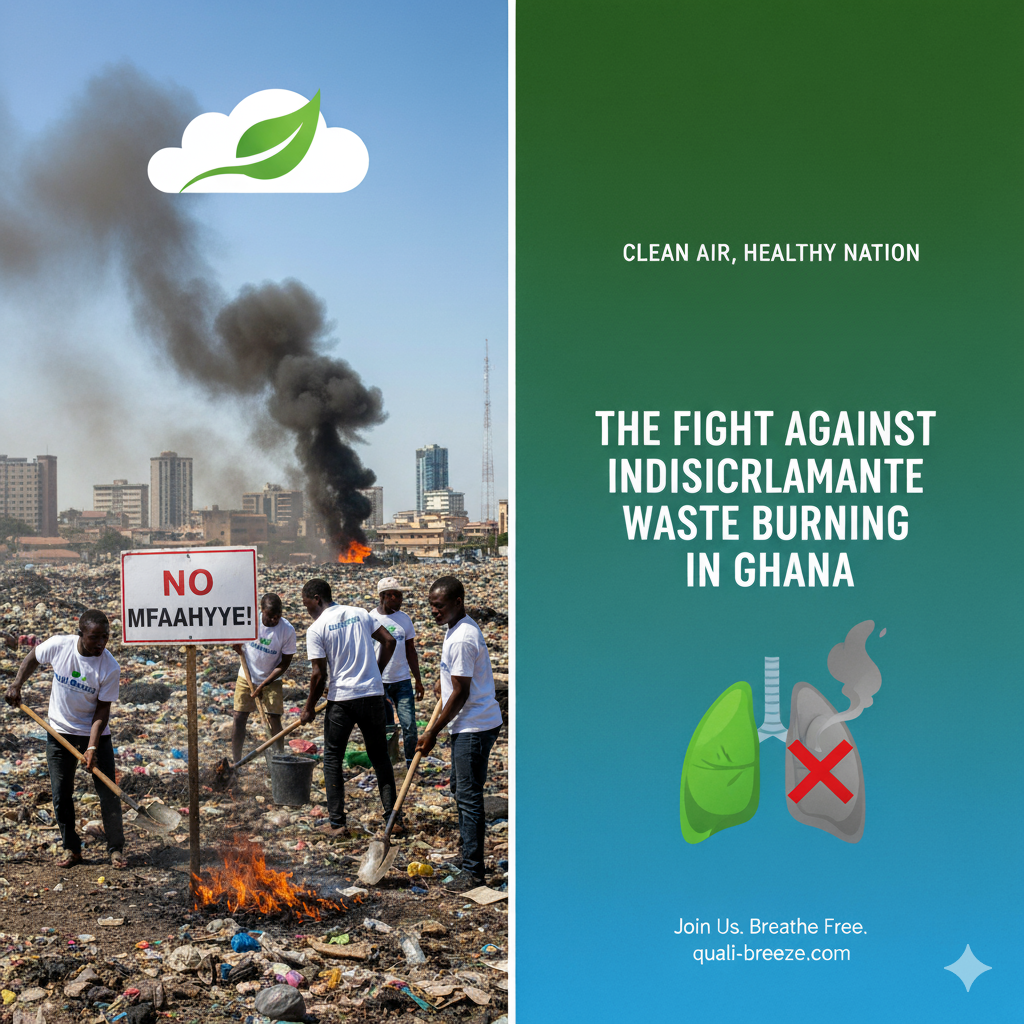
Waste burning has become a pervasive problem in Ghana, with many households and
manufacturing companies engaging in this practice due to lack of awareness, inadequate waste
disposal systems, and inefficient existing infrastructure. This indiscriminate waste burning poses
significant risks to air quality, public health, and the environment.
Waste burning releases toxic pollutants, particulate matter, and greenhouse gases, contributing
to climate change and poor air quality. Inhaling pollutants from waste burning can cause
respiratory issues, such as asthma and lung cancer. Moreover, waste burning creates
unpleasant odors and visual pollution, constituting a community nuisance in our environment.
The state of waste management according to the Ghana Statistical Service (GSS), in the Awutu
Senya East municipal district of the central region, waste burning accounts for approximately
43.4% of waste disposal methods. Only 29.9% of households have their waste collected by
refuse companies, while the rest is disposed of indiscriminately, with burning being a significant
chunk of it.
Regardless of the challenges, there have been past interventions to improve waste
management in some communities but have been ineffective due to factors such as expensive
monthly charges for the average household, unreliable waste management services like inconsistency of collectors to collect waste at stipulated time, infrastructural deficiencies like
bad roads in some communities.
Additionally, the lack of social pressure to stop burning, lack of realistic sanctions and
enforcement and lack of understanding on the implications of burning to their health and wellbeing.
To address these challenges, a collaborative effort from all stakeholders is necessary and
people’s mindsets toward waste must shift towards greater responsibility and awareness.
What can we do?
Since our household waste are classified majorly into food waste (Organic waste) which takes a
huge chuck of our household waste, at approximately 50-65%, while plastic waste and
packaging materials form approximately 20-30% while inorganic waste forms the rest at a
minimal. Examples are metal, cable and non-biodegradable materials.
Unfortunately, the plastics and the packaging materials are often what are burned as food
waste finds its way to decompose into the environment and the non-biodegradable like metals
have a good market value where it is easily exchanged for financial gains.
There is so much we can do as individuals and collectively to make our environment safe and
better by involving all stakeholders on waste segregation at source to reduce the amount of
waste generated and also encourage recycling of plastics.
Regulatory agencies like the EPA has a lot to do, especially on collaborating with local
authorities to drive the message through social groups, religious organizations, Market leaders,
Bus Station Masters to engage the communities on public awareness, strengthen the policy
implementation and drive enforcement with security agencies.
This also serves as an opportunity for young innovators to drive solutions that can bring positive
impact in our communities by driving innovations that can effectively manage waste as the
value chain is quite huge and lucrative as well.
In conclusion, indiscriminate waste burning can be stopped through collaborative efforts from
all stakeholders. By working together, we can reduce air pollution, foster a healthier
environment, and reduce respiratory-related illnesses. It is time for us to take responsibility for
our actions and protect our health and environment.
Paul Nwachukwu is a Business and Sustainability Professional, Co-Founder, Quali-Breeze, an
organization working for the improvement of air quality in our communities.